Curriculum Overview >>>>>>>>
Montessori philosophy can be summed up in one single sentence: “Children teach themselves.”
Maria Montessori said that children have “absorbent minds”, and are driven to build order out
of chaos they perceive in a world full of sights and sounds.
The different areas covered in a Montessori environment in pre-school and elementary are given below.
These areas are taught in different levels for the elementary students.
Practical Life - Practical Life is designed to instill independence,
self-confidence, self-esteem and most importantly self-control. All of these are characteristics
that play a critical role in subsequent intellectual growth. These concepts are developed through
a number of activities such as:
- Care of Person (Personal Care, Dressing, Frames, and Grooming)
- Care of Environment (Cleaning and Polishing)
- Food Preparation
- Fine motor development (Pouring, Squeezing, Twisting, and Hammering)
- Gross Motor Development
Sensorial Work - This area includes materials that help refine the senses and
includes many works that involve seriation and gradation. Exploration, imitation, initiation, and
pattern completion are the objectives of this area. The child explores dimension, shape, color,
texture, weight, aroma, taste, pitch, and their relationships through a series of exercises called
the sensorial materials. These materials isolate various qualities so that the child can experience
each one individually. The materials are largely self-correcting so the child can accomplish the
exercises alone. Moreover, they are structured, building on what has been previously learned.
A sense of order is found in these materials and the child acquires the joy of learning that their
environment also has order. The Sensorial Lessons consist of:
- Auditory Learning (sound)
- Visual Learning (color, size, shape, gradation)
- Tactile Learning (texture, weight, temperature)
- Learning Through Smell (Olfactory - ability to distinguish between and match scents)
- Learning Through Taste (Gustatory- ability to distinguish between salty, sweet, sour)
Language - Phonics-based approach is used for reading. We also incorporate
sight words and whole language when it is appropriate. Each area in language has activities that
emphasize beginning, middle and ending sounds, word building, and reading words. Handwriting is a
built in feature of the language area and children learn to write as they are learning the sounds.
The child at his own pace pursues each of the separate skills involved in the mastery of reading and writing.
The Language Lessons Consist of:
- Auditory Preparation conversation with children storytelling (sequencing) poetry
(rhymes and finger plays) auditory discrimination listening skills identifying sounds
- Visual Preparation recognizing patterns matching and sorting
- Motor Preparation eye to hand coordination strengthening of the hand manuscript writing
- Analysis phonogram sounds blends
- Reading on Word Level phonics reading in context
- Correct Expression vocabulary of objects, attributes, and actions
- Function of Words beginning writing noun and verb identification (introduced)
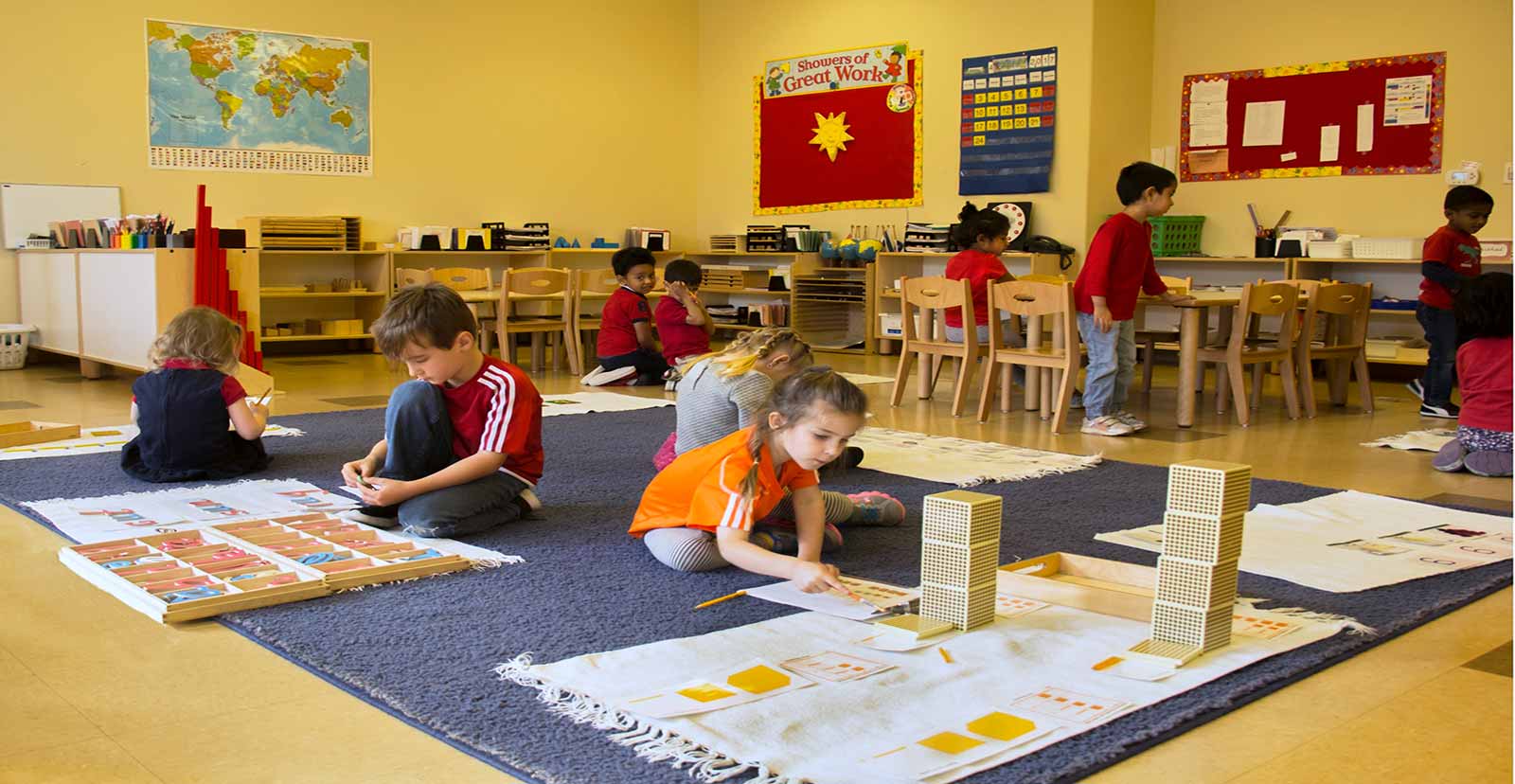
Mathematics - The Montessori mathematical materials isolate each concept and introduce
it to the child in a concrete form using manipulative equipment. Children first learn to associate each numerical
symbol with the proper quantity. The child progresses one step at a time to a more abstract understanding of the
concepts of arithmetic. The Mathematics Lessons consist of:
- Numeration counting numerals 1-9 recognition of numerals
- The Decimal System decimal introduction association of place values understanding the concept of 10
- Linear Counting visual recognition of 1-1000 teens, tens, and 100 identification counting with materials
- Four Operations decimal system: introduces concepts of four operations golden beads: units, tens, hundreds,
thousands addition, multiplication, subtraction, division
- Abstraction: The Bridge after manipulating the golden beads for operations work, the child becomes ready to
recognize the symbolic value of the stamp material
- Memorization actual memorization of the complete tables does not begin until the elementary level-these
activities are intended to provide exploration of numbers/quantities while also providing numerous opportunities for repetition
and engaging the mind for memory
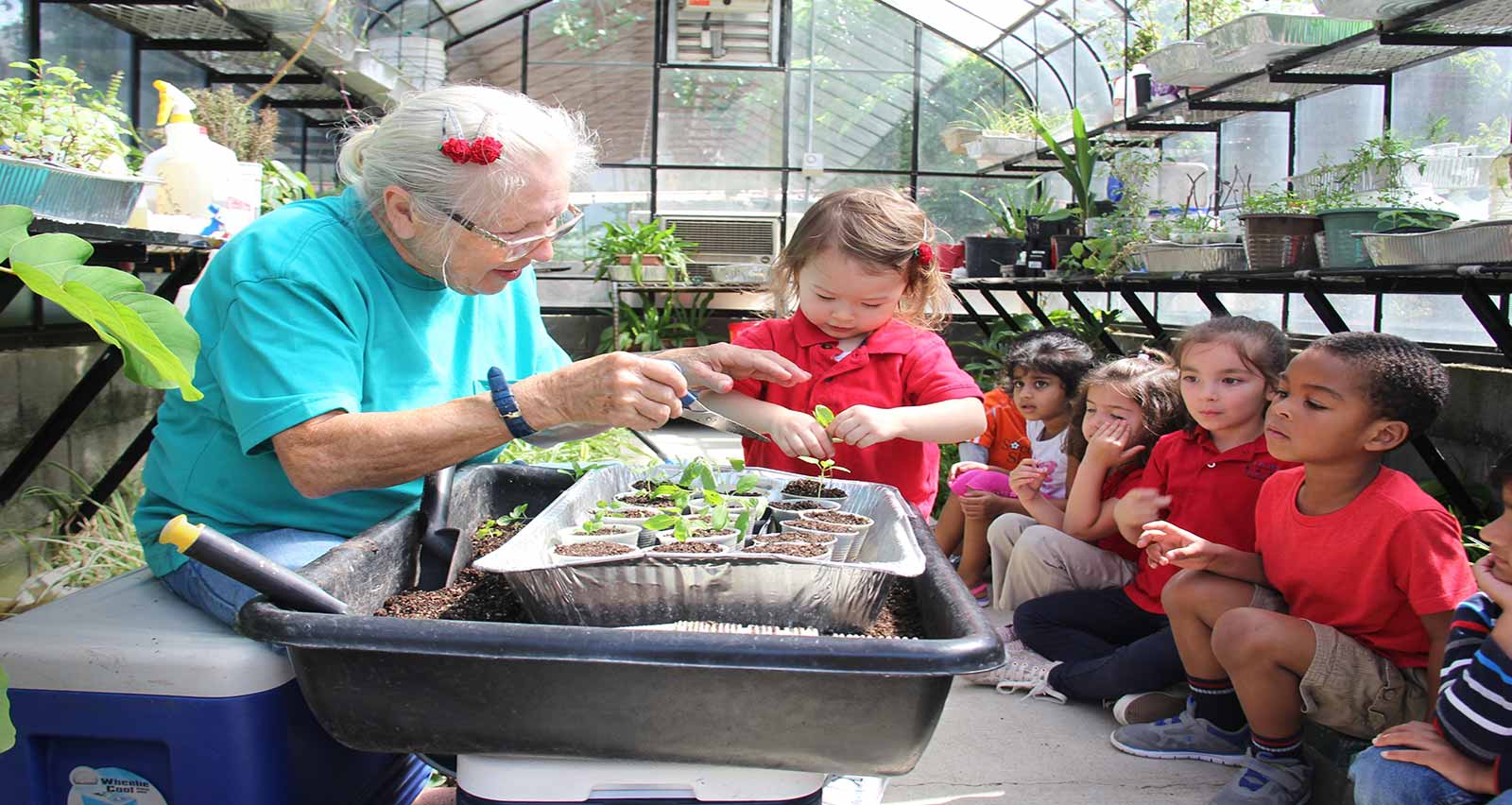
Science - Science is a hands-on activity and in addition to the work
on the shelves that includes biology, botany, zoology, and physical science. The children
have organized time outdoors to study nature. Montessori classes work on small gardens,
window boxes, or tubs in which flowers and vegetables can be grown. Other things include:
- Differentiation between living and non-living things.
- Differentiation between animals and plants; basic characteristic
- First puzzles representing the biological parts of flowers,
root systems and trees, along with the anatomical features of common animals.
These are first used by very young children and puzzles, then as a means to learn
the vocabulary, then are related to photos and/or the "real thing," then traced onto paper,
and finally with labels as a reading experience.
- Nomenclature Cards
- Botany: identifying, naming and labeling the parts of plants, trees, leaves, roots and flowers.
- Zoology: identifying, naming and labeling the external parts of human beings, insects, fish, birds and other animals.
- Introduction of the families of the animal kingdom, and identification and classification of animals into the broad
families. Introduction to the basic characteristics, life-styles, habitats, and means of caring for young of each family in the animal kingdom. (Age 5-7)
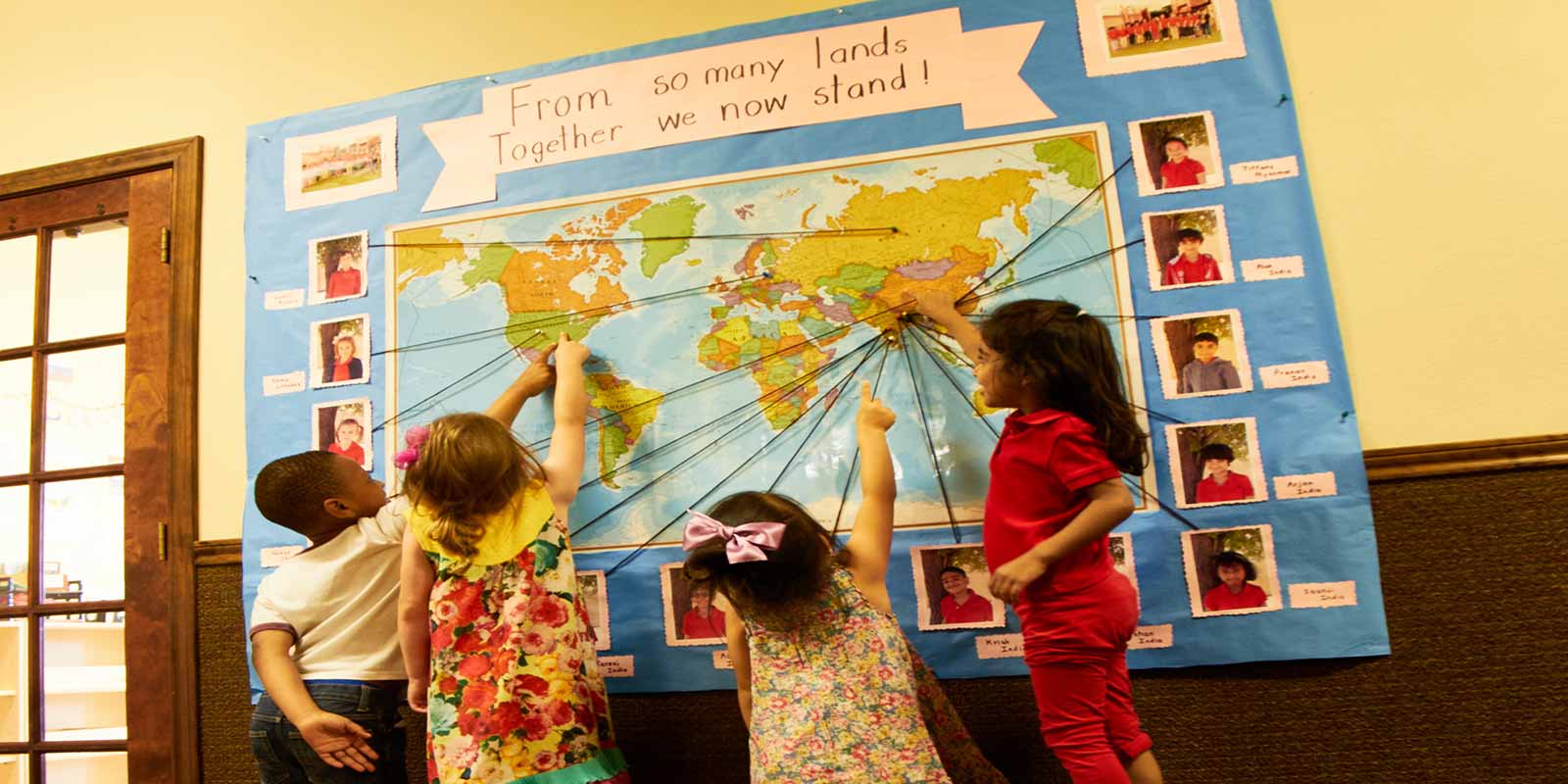
Geography - This area contains puzzle maps of the World and its continents. Children have the opportunity to learn the names,
flags and location of countries. There is a heavy emphasis on the cultural aspects and parents are encouraged to share their culture and customs
in the classroom.
- The Primary Globes (Age 3-5): specially prepared for the very young child that isolate single concepts of globe study -
how land and water are shown, and the corresponding shapes of the continents that they learned from the puzzle maps.
- The Puzzle Maps (Age 3-7): These are specially made maps in the forms of intricate, color-coded, wooden jigsaw puzzles
representing the continent, the countries of each continent, and the states of the U.S. They are presented to the children at an early age,
and are at first enjoyed simply as challenging puzzles. As soon as the children can read, they begin to lay the puzzle pieces out and place
the appropriate name labels to each as a reading and geography exercise.
- Land and Water Formations: materials designed to help the very young child understand basic land and water formations
such as island, isthmus, peninsula, strait, lake, cape, bay, archipelago, etc.
- Transference to maps: Introduction to written names and various forms of maps, along with early study of the flora,
fauna, landscapes and people of the continents.
- An introduction to humankind's search to understand how the Earth was formed, from creation stories to the evidence
of contemporary scientific research: origins, geologic forces, formations of the oceans and atmosphere, continental drift and tectonic plates,
volcanoes, earth quakes, the ice ages and the formation of mountain ranges. (Age 6)
Extra-Curricular Activities >>>>>>>>
The following activities are integral part of the Montessori curriculum. Parents pay no extra cost for these activities.
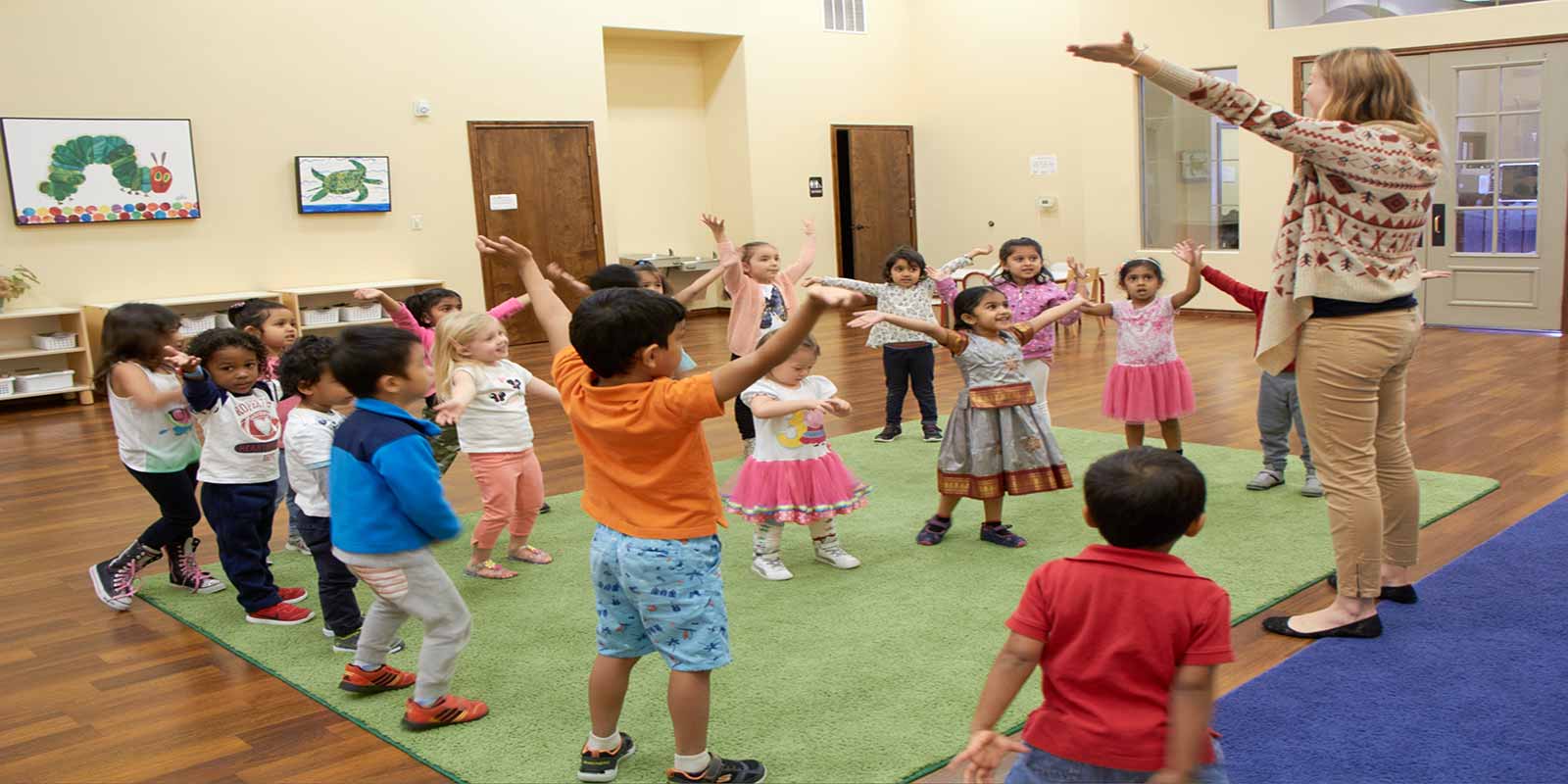
Art & Music - Art and music hold an equal place in the Montessori curriculum,
both in theory and in practice. These areas are also included in the integrated curriculum,
demonstrating the richness of the human mind and spirit. The art curriculum introduces the children
not only to various artistic media but also to the works of famous artists. During the music sessions,
children are involved in movement, singing and playing of various rhythm instruments.
Foreign Language - Children from 18 months will be exposed to Spanish as a foreign
language. It is believed that the younger a child is when he/she is exposed to a new language; the easier it will be for them
to understand, thus making the acquisition of a new language more achievable. We have a qualified Spanish Teacher
to teach our children.
Nature Study - Nature Study is an integral part of Montessori curriculum. Children take care of plants in the classroom.
They learn to water, clean the plants. Coppell Montessori Academy will have a stand alone Greenhouse for children to grow vegetables,
flowers and learn more about the nature.
Computer - Finally, the children are taught how to use a computer. Children are exposed to different children software
through which they learn to draw, play games which enhance their critical thinking. The software what we use helps the children to understand
concepts of cause-effect relationships, to learn about a topic through exploration and experimentation, and to build a bridge between hands-on
experiences and abstract learning.
Physical Exercise - Physical exercise is considered essential for students and adults. The facility includes a gymnasium,
outside covered play areas. As part of daily program children get the opportunity to play outside or inside depending on the weather.
Summer Program >>>>>>>>
Coppell Montessori Academy has a Summer Program that gives the children a break during the day by bringing entertainment to them and
providing an extra dose of crafts, music, cooking, painting, organized games and Spanish and still maintain within the framework of Montessori
philosophy and work.
Our summer program will be held during the months of June and July. The summer program will consist of activities that have been planned to keep
the enthusiasm for learning alive in your child all summer long. The children will continue to have Montessori education daily along with art,
cooking, music, gamemania, art studio, needlepoint and wading pools for the youngest children. Entertainment such as puppet shows, magician,
bouncing house, pony rides, train rides, face painting and petting zoo have been scheduled. Schedules will be posted in every classroom door for
each respective month.
We welcome children from Montessori and non-Montessori backgrounds. Once you experience the Montessori learning you may want to look at our school
year programs for the future.
You are welcome to enroll your children for a period of one month or for a period of two weeks. In this event the tuition will be prorated.
Come and visit us for more information. |